
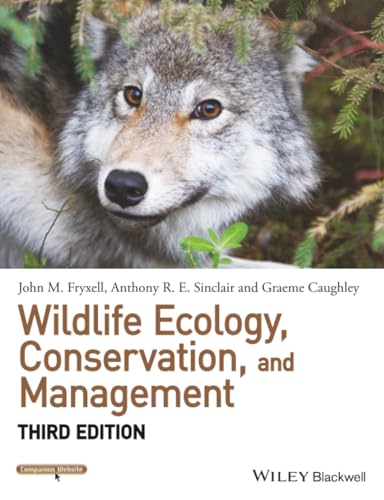
Wildlife Ecology, Conservation, and Management
Material type: TextPublication details: West Sussex : John Wiley & Sons, 2014.Edition: Third EditionDescription: xiii,509p. 31cmISBN:
- 9781118291078
- 639.9 FRY
| Item type | Current library | Collection | Shelving location | Call number | Status | Barcode | |
|---|---|---|---|---|---|---|---|
 Books |
Unity College Library | Non-fiction | Environmental Studies | 639.9 FRY (Browse shelf(Opens below)) | Available | 12018 |
Preface
About the companion website
1 Introduction: goals and decisions
1.1 How to use this book
1.2 What is wildlife conservation and management?
1.3 Goals of management
1.4 Hierarchies of decision
1.5 Policy goals
1.6
Feasible options
1.7 Summary
Part 1 Wildlife ecology
2 Food and nutrition
2.1 Introduction
2.2 Constituents of food
2.3 Variation in food supply
2.4 Measurement of food supply
2.5 Basal metabolic rate and food requirement
2.6 Morphology of herbivore digestion
2.7 Food passage rate and food requirement
2.8 Body size and diet selection
2.9 Indices of body condition
2.10 Summary
3 Home range and habitat use
3.1 Introduction
3.2 Estimating home range size and utilization frequency
3.3 Estimating habitat availability and use
3.4 Selective habitat use
3.5 Using resource selection functions to predict population response
3.6 Sources of variation in habitat use
3.7 Movement within the home range
3.8 Movement among home ranges
4 Dispersal, dispersion, and distribution
4.1 Introduction
4.2 Dispersal
4.3 Dispersion
4.4 Distribution
4.5 Distribution, abundance, and range collapse
4.6 Species reintroductions or invasions
4.7 Summary
5 Population growth and regulation
5.1 Introduction
5.2 Rate of increase
5.3 Geometric or exponential population growth
5.4 Stability of populations
5.5 The theory of population limitation and regulation
5.6 Evidence for regulation
5.7 Applications of regulation
5.8 Logistic model of population regulation
5.9 Stability, cycles, and chaos
5.10 Intraspecific competition
5.11 Interactions of food, predators, and disease
5.12 Summary
6 Competition and facilitation between species
6.1 Introduction
6.2 Theoretical aspects of interspecific competition
6.3 Experimental demonstrations of competition
6.4 The concept of the niche
6.5 The competitive exclusion principle
6.6 Resource partitioning and habitat selection
6.7 Competition in variable environments
6.8 Apparent competition
6.9 Facilitation
6.10 Applied aspects of competition
6.11 Summary
7 Predation
7.1 Introduction
7.2 Predation and management
7.3 Definitions
7.4 The effect of predators on prey density
7.5 The behavior of predators
7.6 Numerical response of predators to prey density
7.7 The total response
7.8 Behavior of the prey
7.9 Summary
8 Parasites and pathogens
8.1 Introduction and definitions
8.2 Effects of parasites
8.3 The basic parameters of epidemiology
8.4 Determinants of spread
8.5 Endemic pathogens
8.6 Endemic pathogens: synergistic interactions with food and predators
8.7 Epizootic diseases
8.8 Emerging infectious diseases of wildlife
8.9 Parasites and the regulation of host populations
8.10 Parasites and host communities
8.11 Parasites and conservation
8.12 Parasites and control of pests
8.13 Summary
9 Consumer-resource dynamics
9.1 Introduction
9.2 Quality and quantity of a resource
9.3 Kinds of resource
Consumer-resource dynamics: general theory 9.4
9.5 Kangaroos and their food plants in semi-arid Australian savannas
9.6 Wolf-moose-woody plant dynamics in the boreal forest
9.7 Other population cycles
9.8 Summary
10 The ecology of behavior
10.1 Introduction
10.2 Diet selection
10.3 Optimal patch or habitat use
10.4 Risk-sensitive habitat use
10.5 Social behavior and foraging
10.6 Summary
11 Climate change and wildlife
11.1 Introduction
11.2 Evidence for climate change
11.3 Wildlife responses to climate change
11.4 Mechanisms of response to climate change
11.5 Complex ecosystem responses to climate change
11.6 Summary
Part 2 Wildlife conservation and management
12 Counting animals
12.1 Introduction
12.2 Total counts
12.3 Sampled counts: the logic
12.4 Sampled counts: methods and arithmetic
12.5 Indirect estimates of population size
12.6 Indices
12.7 Harvest-based population estimates
12.8 Summary
13 Age and stage structure
13.1 Introduction
13.2 Demographic rates
13.3 Direct estimation of life table parameters
13.4 Indirect estimation of life table parameters
13.5 Relationships among parameters
13.6 Age-specific population models
13.7 Elasticity of matrix models
13.8 Stage-specific models
13.9 Elasticity of the loggerhead turtle model
13.10 Short-term changes in structured populations
13.11 Environmental stochasticity and age-structured populations
13.12 Summary
14 Experimental management
14.1 Introduction
14.2 Differentiating success from failure
14.3 Technical judgments can be tested
14.4 The nature of the evidence
14.5 Experimental and survey design
14.6 Some standard analyses
14.7 Summary
15 Model evaluation and adaptive management
15.1 Introduction
15.2 Fitting models to data and estimation of parameters
15.3 Measuring the likelihood of the observed data
15.4 Evaluating the likelihood of alternate models using AIC
15.5 Adaptive management
15.6 Summary
16 Population viability analysis
16.1 Introduction
16.2 Environmental stochasticity
16.3 PVA based on the exponential growth model
16.4 PVA based on the diffusion model
16.5 PVA based on logistic growth
16.6 Demographic stochasticity
16.7 Estimating both environmental and demographic stochasticity
16.8 PVA based on demographic and environmental stochasticity
16.9 Strengths and weaknesses of PVA
16.10 Extinction caused by environmental change
16.11 Extinction threat due to introduction of exotic predators or competitors
16.12 Extinction threat due to unsustainable harvesting
16.13 Extinction threat due to habitat loss
16.14 Summary
Conservation in practice
17
17.1 Introduction
17.2 How populations go extinct
17.3 How to prevent extinction
17.4 Rescue and recovery of near-extinctions
17.5 Conservation in National Parks and reserves
17.6 Community conservation outside National Parks and reserves
17.7 International conservation
17.8 Summary
18
Wildlife harvesting
18.1 Introduction
18.2
Fixed-quota harvesting strategy
18.3 Fixed-proportion harvesting strategy
18.4 Harvesting in practice: dynamic variation in quotas or effort
18.5 No-harvest reserves
18.6
Age- or sex-biased harvesting
18.7 Commercial harvesting
18.8 Bioeconomics
18.9 Game cropping and the discount rate
18.10 Summary
19 Wildlife control
19.1 Introduction
19.2 Definitions
19.3 Effects of control
19.4 Objectives of control
19.5 Determining whether control is appropriate
19.6
Methods of control
19.7
Summary
20
Evolution and conservation genetics
20.1 Introduction
20.2 Maintenance of genetic variation
20.3
Natural selection
20.4
Natural selection and life history tradeoffs
20.5 Natural selection due to hunting
20.6
Natural selection due to fishing
20.7 Selection due to environmental change
20.8 Ecological dynamics due to evolutionary changes
20.9 Heterozygosity
20.10 Genetic drift and mutation
20.11 Inbreeding depression
20.12 How much genetic variation is needed?
20.13 Effective population size
20.14 Effect of sex ratio
20.15 How small is too small?
20.16 Summary
21 Habitat loss and metapopulation dynamics
21.1 Introduction
21.2 Habitat loss and fragmentation
21.3 Ecological effects of habitat loss
21.4 Metapopulation dynamics
21.5 Territorial metapopulations
21.6 Mainland-island metapopulations
21.7 Source-sink metapopulations
21.8 Metacommunity dynamics of competitors
21.9 Metacommunity dynamics of predators and prey
21.10 Corridors
21.11 Summary
22 Ecosystem management and conservation
22.1 Introduction
22.2 Definitions
22.3 Gradients of communities
22.4 Niches
22.5 Food webs and intertrophic interactions
22.6 Community features and management consequences
22.7 Multiple states
22.8 Regulation of top-down and bottom-up processes
22.9 Ecosystem consequences of bottom-up processes
22.10 Ecosystem disturbance and heterogeneity
22.11 Ecosystem management at multiple scales
22.12 Biodiversity
22.13 Island biogeography and dynamic processes of diversity
22.14 Ecosystem function
22.15 Summary
Appendices
Glossary
References
Index
There are no comments on this title.