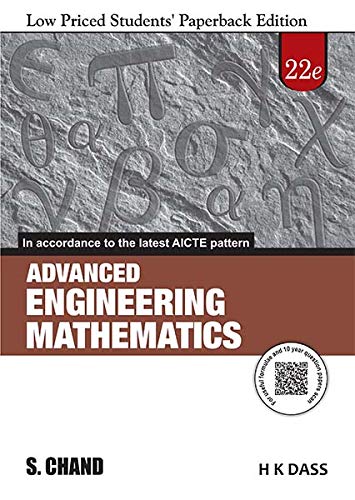
Amazon cover image
Image from Amazon.com
Image from Google Jackets

Advanced engineering mathematics

By: Material type: TextPublication details: New Delhi, India ; S Chand & Company Limited, 2022.Edition: 22nd editionDescription: xxvi, 1410pISBN:
  • 9789352837182
DDC classification:
  • 510 DAS
Contents:
CONTENTS 1. PARTIAL DIFFERENTIATION 1.1 Introduction 1.2 Limit 1.3 Working rule to find the limit 1.4 Continuity 1.5 Working rule for continuity at a point (a. b) 1.6 Types of discontinuity 1.7 Partial derivatives 1.8 Partial derivatives of higher orders 1.9 Which variable is to be treated as constant 1.10 Homogeneous function 1.11 Euler's theorem on homogeneous function 1.12 Total differential 1.13 Total differential co-efficient 1.14 Change of two independent variables x and y by any other variables 1.15 Change in the independent variables x and y by other two variables u and v. 1.16 Change in both the independent and dependent variables (polar coordinates) 1.17 Important deductions 1.18 Typical cases 1.19 Geometrical interpretation of and дх ду 1.20 Tangent plane to a surface 1.21 Error determination 1.22 Jacobians 1.23 Properties of Jacobians 1.24 Jacobian of implicit functions 1.25 Partial derivatives of implicit functions by Jacobian 1.26 Taylor's series of two variables 1.27 Maximum value 1.28 Conditions for extremum values 1.29 Working rule to find extremum values 1.30 Lagrange method of undetermined multipliers 2. MULTIPLE INTEGRAL 2.1 Double integration 2.2 Evaluation of double integral 2.3 Evaluation of double integrals in polar co-ordinates 2.4 Change of order of integration 2.5 Change of variables 2.6 Area in cartesian co-ordinates 2.7 Area in polar co-ordinates 2.8 Volume of solid by rotation of an area (double integral) 2.9 Centre of gravity 2.10 Centre of gravity of an arc 2.11 Triple integration 2.12 Integration by change of cartesian coordinates into spherical coordinates 2.13 Volume dx dy dz 2.14 Volume of solid bounded by sphere or by cylinder 2.15 Volume of solid bounded by cylinder or cone 2.16 Surface area 2.17 Calculation of mass 2.18 Centre of gravity 2.19 Moment of inertia of a solid 2.20 Centre of pressure 3. DIFFERENTIAL EQUATIONS 3.1 Definition 3.2 Order and degree of a differential equation 3.3 Formation of differential equations 3.4 Solution of a differential equation 3.5 Differential equations of the first order and first degree 3.6 Variables separable 3.7 Homogeneous differential equations 3.8 Equations reducible to homogeneous form 3.9 Linear differential equations 3.10 Equations reducible to the linear form (bernoulli equation) 3.11 Exact differential equation 3.12 Equations reducible to the exact equations 3.13 Equations of first order and higher degree 3.14 Orthogonal trajectories 3.15 Polar equation of the family of curves 3.16 Electrical circuit kirchhoff's laws 3.17 Vertical motion 3.18 Linear differential equations of second order with constant coefficients 3.19 Complete solution = complementary function + particular integral 3.20 Method for finding the complementary function 3.21 Rules to find particular integral 3.22 1/(f(D)) * e ^ (ax) = 1/(f(a)) * e ^ (ax) 3.23 | 1/(f(D)) * x ^ n = [f(D)] ^ - 1 * x ^ n . 3.24 1/(f(D ^ 2)) * sin ax = (sin ax)/(f(- a ^ 2)) 1/(f(D ^ 2)) * cos ax = (cos ax)/(f(- a ^ 2)) 3.25 1 f(D) e^ ax * phi(x)= e ^ (ax) * 1/(f(D + a)) . phi(x) 3.26 To find the value of 1/(f(D)) * x ^ n * sin ax 3.27 General method of finding the particular integral of any function (x) 3.28 Cauchy euler homogeneous linear equations 3.29 Legendre's homogeneous differential equations 3.30 Method of variation of parameters 3.31 Simultaneous differential equations d" y 3.32 Equation of the type = f(x) dx" d² y 3.33 Equation of the type dr =f(y) A 3.34 Equations which do not contain 'y' directly 3.35 Equations that do not contain 'x' directly 3.36 Equations whose one solution is known 3.37 Normal form (removal of first devivative) 3.38 Method of solving linear differential equations by changing the independent variable 3.39 Applications of differential equations of second order 4. DETERMINANTS AND MATRICES 4.1 Introduction 4.2 Determinant 4.3. Determinant as eliminant 4.4. Minor 4.5. Cofactor 4.6 Rules of sarrus (for third order determinants only) 4.7. Properties of determinants 4.8 Factor theorem 4.9 Pivotal condensation method 4.10 Conjugate elements 4.11 Special types of determinants 4.12 Laplace method for the expansion of a determinant in terms of first two rows 4.13 Application of determinants 4.14 Solution of simultaneous linear equations by determinants (cramer's rule) 4.15 Rule for multiplication of two determinants 4.16 Condition for consistency of a system of simultaneous homogeneous equations 4.17 Consistency for a system of three simultaneous linear equations with three unknowns 4.18 Matrices 4.19 Various types of matrices 4.20 Addition of matrices 4.21 Properties of matrix addition 4.22 Subtraction of matrices 4.23 Scalar multiple of a matrix 4.24 Multiplication 4.25 (ABYBA 4.26 Properties of matrix multiplication 4.27 Mathematical induction 4.28 Adjoint of a square matrix 4.29 Property of adjoint matrix 4.30 Inverse of a matrix 4.31 Elementary transformations 4.32 Elementary matrices 4.33 Theorem 4.34 To compute the inverse of a matrix from elementary 4.35 The inverse of a symmetric matrix 4.36 Rank of a matrix 4.37 Normal form (canonical form) 4.38 Rank of matrix by triangular form 4.39 Solution of simultaneous equations 4.40 Gauss jordan method 4.41 Types of linear equations 4.42 Consistency of a system of linear equations 4.43 Homogeneous equations 4.44 Linear dependence and independence of vectors 4.45 Linearly dependence and independence of vectors by rank method 4.46 Another method (adjoint method) to solve linear equations 4.47 Partitioning of matrices 4.48 Multiplication by sub-matrices 4.49 Inverse by partitioning 4.50 Eigen values 4.51 Cayley-hamilton theorem 4.52 Power of matrix (by cayley hamilton theorem) 4.53 Characteristic vectors or eigen vectors 4.54 Properties of eigen vectors 4.55 Non-symmetric matrices with non-repeated eigen values 4.56 Non-symmetric matrix with repeated eigen values 4.57 Symmetric matrices with non repeated eigen values 4.58 Symmetric matrices with repeated eigen values 4.59 Diagonalisation of a matrix 4.60 Theorem on diagonalization of a matrix 4.61 Powers of a matrix (by diagonalisation) 4.62 Sylvester theorem 4.63 Quadratic forms 4.64 Quadratic form expressed in matrices 4.65 Linear transformation of quadratic form 4.66 Canonical form of sum of the squares form using linear transformation 4.67 Canonical form of sum of the squares form using orthogonal transformation 4.68 Classification of definiteness of a quadratic form 4.69 Differentiation and integration of matrices 4.70 Complex matrices 4.71 Theorem 4.72 Transpose of conjugate of a matrix 4.73 Hermitian matrix 4.74 Skew-hermitian matrix 4.75 Periodic matrix 4.76 Idempotent matrix 4.77 Unitary matrix 4.78 The modulus of each characteristic root of a unitary matrix is unity 5. VECTORS 5.1 Vectors 5.2 Addition of vectors 5.3 Rectangular resolution of a vector 5.4 Unit vector 5.5 Position vector of a point 5.6 Ratio formula 5.7 Product of two vectors 5.8 Scalar, or dot product 5.9 Useful results 5.10 Work done as a scalar product 5.11 Vector product or cross product 5.12 Vector product expressed as a determinant 5.13 Area of parallelogram 5.14 Moment of a force 5.15 Angular velocity 5.16 Scalar triple product 5.17 Geometrical interpretation 5.18 Coplanarity questions 5.19 Vector product of three vectors 5.20 Scalar product of four vectors 5.21 Vector product of four vectors 5.22 Vector function 5.23 Differentiation of vectors 5.24 Formulae of differentiation 5.25 Scalar and vector point functions 5.26 Gradient of a scalar function 5.27 Geometrical meaning of gradient, normal 5.28 Normal and directional derivative 5.29 Divergence of a vector function 5.30 Physical interpretation of divergence 5.31 Curl 5.32 Physical meaning of curl 5.33 Line integral 5.34 Surface integral 5.35 Volume integral 5.36 Green's theorem (for a plane) 5.37 Area of the plane region by green's theorem 5.38 Stoke's theorem (relation between line integral and surface integral) 5.39 Another method of proving stoke's theorem 5.40 Gauss's theorem of divergence 6. COMPLEX NUMBERS 6.1 Introduction 6.2 Complex numbers 6.3 Geometrical representation of imaginary numbers 6.4 Argand diagram 6.5 Equal complex numbers 6.6 Addition of complex numbers 6.7 Addition of complex numbers by geometry 6.8 Subtraction 6.9 Powers of i 6.10 Multiplication 6.11 / (iota) as an operator 6.12 Conjugate of a complex number 6.13 Division 6.14 Division of complex numbers by geometry 6.15 Modulus and argument 6.16 Polar form 6.17 Types of complex numbers 6.18 Square root of a complex number 6.19 Exponential and circular functions of complex variables 6.20 De moivre's theorem (by exponential function) 6.21 De moivre's theorem (by induction) 6.22 Roots of a complex number 6.23 Circular functions of complex numbers 6.24 Hyperbolic functions 6.25 Relation between circular and hyperbolic functions 6.26 Formulae of hyperbolic functions 6.27 Separation of real and imaginary parts of circular functions 6.28 Separation of real and imaginary parts of hyperbolic functions 6.29 Logarithmic function of a complex number 6.30 Inverse functions 6.31 Inverse hyperbolic functions 6.32 Some other inverse functions 7. FUNCTIONS OF A COMPLEX VARIABLE 7.1 Introduction 7.2 Complex variable 7.3 Function of a complex variable 7.4 Neighbourhood of z 7.5 Limit of a function of a complex variable 7.6 Continuity 7.7 Continuity in terms of real and imaginary parts 7.8 Differentiability 7.10 The necessary condition for f(z) to be analytic 7.9 Analytic function 7.11 Sufficient condition for f(z) to be analytic 7.12 C-R equations in polar form 7.13 Derivative of or f(z) in polar form 7.14 Orthogonal curves 7.15 Harmonic function 7.16 Application to flow problems 7.17 Velocity potential function 7.18 Method to find the conjugate function 7.19 Milne thomson method (to construct an analytic function) 7.20 Working rule: to construct an analytic function by milne thomson method 7.21 Partial differentiation of function of complex variable 7.22 Introduction (line integral) 7.23 Important definitions 7.24 Cauchy's integral theorem 7.25 Extension of cauchy's theorem to multiple connected region 7.26 Cauchy integral formula 7.27 Cauchy integral formula for the derivative of an analytic function 7.28 Zero of analytic function 7.29 Principal part 7.30 Singular point 7.31 Removable singularity 7.32 Working rule to find singularity 7.33 Theorem 7.34 Definition of the residue at a pole 7.35 Residue at infinity 7.36 Method of finding residues 7.37 Residue by definition 7.38 Formula: residue = lim z -> a (z - a) * f(z) 7.39 Formula: residue f(a)= 1 (n-1)! \ (d ^ (n - 1))/(d * z ^ (n - 1)) \ (z-a)^ n f(z)]\ z=a 7.40 Formula: res. (A1z = a) = (phi(a))/(psi' * (a)) 7.41 Formula: residue = coefficient of 1/t 7.42 Cauchy's residue theorem 7.43 Evaluation of real definite integrals by contour integration 7.44 Integration round unit circle of the type where f_{1}(x) and f_{2}(x) are polynomial in x. 7.45 Evaluation of int - infty ^ infty f 1 (x) f 2 (x) d 8. TRANSFORMATION 8.1 Geometrical representation 8.2 Transformation 8.3 Conformal transformation 8.4 Theorem. Iff(z) is analytic, mapping is conformal 8.5 Theorem 8.6 Translation w = z + c 8.7 Rotation w= ze 8.8 Magnification 8.9 Magnification and rotation 8.10 Inversion and reflection 8.11 Bilinear transformation (mobius transformation) 8.12 Invariant points of bilinear transformation 8.13 Cross-ratio 8.14 Theorem 8.15 Properties of bilinear transformation 8.16 Methods to find bilinear transformation 8.17 Inverse point with respect to a circle 8.18 Transformation: w = z ^ 2 8.19 Transformation: w = z ^ n * (n \in n) 8.20 Transformation: w = z + 1 / z 8.21 Transformation: w = e ^ 2 8.22 Transformation: w = cosh(z) 8.23 Schwarz-christoffel transformation 9. TAYLOR'S AND LAURENT'S SERIES 9.1 Introduction 9.2 Convergence of a series of complex terms 9.3 Power series 9.4 Region of convergence 9.5 Radius of convergence of power series 9.6 Method of expansion of a function 9.7 Taylor's theorem 9.8 Laurent's theorem 9.9 Iff (2) has a pole at z = a then |f(z)| → z -> a 10. SPECIAL FUNCTIONS 10.1 Special functions 10.2 Power series solutions of differential equations 10.3 Ordinary point 10.4 Solution about singular points 10.5 Frobenius method 10.6 Bessel's equation 10.7 Solution of bessel's equation 10.8 Bessel functions, f_{n}(x) 10.9 Recurrence formulae 10.10 Equations reducible to bessel's equation 10.11 Orthogonality of bessel functions 10.13 Trigonometric expansion involving bessel functions 10.12 A generating function j_{n}(x) 10.14 Bessel's integral 10.15 Fourier-bessel expansion 10.16 Ber and bei functions 10.17 Legendre's equation 10.18 Legendre's polynomial p_{n}(x) 10.19 Legendre's function of the second kind LE.. Q_{n}(x) 10.20 General solution of legendre's equation 10.21 Rodrigue's formula 10.22 Legendre polynomials 10.23 A generating function of legendre's polynomial 10.24 Orthogonality of legendre polynomials 10.25 Recurrence formulae for p_{n}(x) 10.26 Fourier-legendre expansion 10.27 Laguerres differential equation 10.28 Strum-liouville equation 10.29 Orthogonality 10.30 Orthogonality of eigen functions 11. PARTIAL DIFFERENTIAL EQUATIONS 11.1 Partial differential equations 11.2 Order 11.3 Classification 11.4 Method of forming partial differential equations 11.5 Solution of equation by direct integration 11.6 Lagrange's linear equation is an equation of the type 11.7 Working rule 11.8 Method of multipliers 11.9 Partial differential equations non-linear in p and q. 11.10 Charpit's method 11.11 Linear homogeneous partial differential equations of n order with constant coefficients 11.12 Rules for finding the complementary function 11.13 Rules for finding the particular integral 11.14 Non-homogeneous linear equations 11.15 Monge's method (non linear equation of the second order) 11.16 Types of partial differential equations 11.17 Method of separation of variables 11.18 Equation of vibrating string 11.19 Solution of wave equation by D' almbert's method 11.20 One dimensional heat flow 11.21 Two dimensional heat flow 11.22 Laplace equation in polar co-ordinates 11.23 Transmission line equations 12. STATISTICS 12.1 Statistics 12.2 Frequency distribution 12.3 Graphical representation. 12.4 Average or measures of central tendency 12.5 Arithmetic mean 12.6 Median 12.7 Mode 12.8 Geometric mean 12.9 Harmonic mean 12.10 Average deviation or mean deviation 12.11 Standard deviation 12.12 Shortest method for calculating standard deviation 12.13 Moments 12.14 Moment generating function 12.15 Skewness 12.16 Correlation 12.17 Scatter or dot-diagram 12.18 Karl pearson's coefficient of correlation 12.19 Short-cut method 12.20 Spearman's rank correlation 12.21 Spearman's rank correlation coefficient 12.22 Regression 12.23 Line of regression 12.24 Equations to the lines of regression 12.25 Error of prediction 810-899 81 82 13. PROBABILITY 13.1 Probability 13.2 Definitions 13.3 Addition law of probability 13.4 Multiplication law of probability 13.5 Conditional probability 13.6 Bayes theorem 13.7 Discrete probability distribution 13.8 Binomial distribution p (r) "c, p 13.9 Mean of binomial distribution 13.10 Standard deviation of binomial distribution 13.11 Central moments: (moments about the mean) 13.12 Moment generating functions of binomial distribution about origin 13.13 Recurrence relation for the binomial distribution 13.14 Poisson distribution 13.15 Mean of poisson distribution 13.16 Standard deviation of poisson distribution 13.17 Mean deviation 13.18 Moment generating function of poisson distribution 13.19 Cumulants 13.20 Recurrence formula for poisson distribution 13.21 Continuous distribution T 13.22 Moment generating function of the continuous probability distribution about xa is given by 13.23 Normal distribution 13.24 Normal curve 13.25 Mean for normal distribution 13.26 Standard deviation for normal distribution 13.27 Median of the normal distribution 13.28 Mean deviation about the mean u 13.29 Mode of the normal distribution 13.30 Moment of normal distribution 13.31 Area under the normal curve 13.32 Other distributions 13.33 Population (universe) 13.34 Sampling 13.35 Parameters and statistics 13.36 Aims of a sample 13.37 Types of sampling 13.38 Sampling distribution 13.39 Standard error (S.E.) 13.40 Sampling distribution of means from infinite population 13.41 Sampling distribution of the variance 13.42 Testing hypothesis 13.43 Null hypothesis (h) 13.44 Errors 13.45 Level of significance 13.46 Test of significance 13.47 Confidence limits 13.48 Test of significance of large samples (n > 30) 13.49 Sampling distribution of the proportion 13.50 Estimation of the parameters of the population 13.51 Comparison of large samples 13.52 The t-distribution (for small sample) 13.53 Working rule 13.54 Testing for difference between means of two small samples 13.55 The chi-square distribution 13.56 Degree of freedom (df) 13.57 x ^ 2 - curve 13.58 Goodness of fit 13.59 Steps for testing 13.60 F-distribution has the following application 13.61 Fisher's z-distribution 14. FOURIER SERIES 14.1 Periodic functions 14.2 Fourier series 14.3 Dirichlet's conditions for a fourier series 14.4 Advantages of fourier series 14.5 Useful integrals 14.6 Determination of fourier coefficients (euler's formulae) 14.7 Function defined in two or more sub-ranges 14.8 (A) even function 14.9 Half-range series, period 0 to pi 14.10 Change of interval and functions having arbitrary period 14.11 Parseval's formula 14.12 Fourier series in complex form 14.13 Practical harmonic analysis 15. LAPLACE TRANSFORMATION 15.1 Introduction 15.2 Laplace transform 15.3 Important formulae 15.4 Properties of laplace transforms 15.5 Laplace transform of the derivative ff(t) 15.6 Laplace transform of derivative of order n 15.7 Laplace transform of integral of f(t) 15.8 Laplace transform of t. F (T) (multipication by T) 15.9 Laplace transform of 1/t * f(t) division by t) 15.10 Unit step function 15.11 Second shifting theorem 15.12 Theorem 15.13 Impulse function 15.14 Periodic functions 15.15 Convolution theorem 15.16 Laplace transform of bessel functions/ (x) and/(x) 15.17 Evaluation of integrals 15.18 Formulation of laplace transform 15.19 Properties of laplace transform 15.20 Inverse laplace transforms 15.21 Important formulae 15.22 Multiplication by s 1 ) 15.23 Division by s (multiplication by 15.24 First shifting property 15.25 Second shifting property 15.26 Inverse laplace transforms of derivatives 15.27 Inverse laplace transform of integrals. 15.28 Partial fractions method 15.29 Inverse laplace transform by convolution 15.30 Solution of differential equations by laplace transforms 15.31 Solution of simultaneous differential equations by laplace transforms 15.32 Inversion formula for the laplace transform 15.33 Heaviside's inverse formula of F(s) G(s) 16. INTEGRAL TRANSFORMS 16.1 Introduction 16.2 Integral transforms 16.3 Fourier integral theorem 16.4 Fourier sine and cosine integrals 16.5 Fourier's complex integral 16.6 Fourier transforms 16.7 Fourier sine and cosine transforms 16.8 Properties of fourier transforms 16.9 Convolution 16.10 Parseval's identity for fourier transforms 16.11 Parseval's identity for cosine transform 16.12 Parseval's identity for sine transform 16.13 Fourier transform of derivatives 16.14 Relationship between fourier and laplace transforms 16.15 Solution of boundary value problems by using integral transform 16.16 Fourier transforms of partial derivative of a function 16.17 Finite fourier transforms 16.18 Finite fourier sine and cosine transforms of derivatives 17. NUMERICAL TECHNIQUES 17.1 Introduction 17.2 Solution of the equations graphically 17.3 Newton-raphson method or successive substitution method 17.4 Rule of false position (regula falsi) 17.5 Iteration method 17.6 Solution of linear systems 17.7 Crout's method 17.8 Iterative methods or indirect methods 17.9 Jacobi's method 17.10 Gauss-seidel method 17.11 Solution of ordinary differential equations 17.12 Taylor's series method 17.13 Picard's method of successive approximations 17.14 Euler's method 17.15 Euler's modified formula 17.16 Runge's formula 17.17 Runge's formula (third order) 17.18 Runge-kutta formula (fourth order) 17.19 Higher order differential equations 18. NUMERICAL METHODS FOR SOLUTION OF PARTIAL DIFFERENTIAL EQUATIONS 18.1 General linear partial differential equations 18.2 Finite-difference approximation to derivatives 18.3 Solution of partial differential equation (laplace equation) 18.4 Jacobi's iteration formula 18.5 Gauss-seidel method 18.6 Successive over-relaxation or S.O.R. Method 18.7 Poisson equation 18.8 Heat equation (parabolic equation) 18.9 Wave equation (hyperbolic equation) 19. CALCULUS OF VARIATION 1092-1 19.1 Introduction 19.2 Functionals 19.3 Definition 19.4 Euler's equation 19.5 Extremal 19.6 Isoperimetric problems 19.7 Functionals of second order derivatives 20. TENSOR ANALYSIS 20.1 Introduction 20.2 Co-ordinate transformation MROGSHAR 20.3 Summation convention 20.4 Summation of co-ordinates 20.5 Relation between the direction cosines of three mutually perpendicular straight lines 20.6 Transformation of velocity components on change from one system of rectangular axes to another 20.7 Rank of a tensor 20.8 Fast onder tensors 20.9 Secced order tensors 20.10 Tensors of any order 2011 Tensor of zero order 2012 Algebraic operations on tensors 20.13 Product of two tensors 20.14 Quotient law of tensors 20.15 Contraction theorem 20.16 Symmetric and antisymmetric tensors 20.17 Symmetric and skew symmetric tensors 20.18 Theorem 20.19 A fundamental property of tensors 20.20 Zero tensor 20.21 Two special tensors 20.22 Kronecker tensor 20.23 Isotropic tensor 20.24 Relation between alternate and kronecker tensor 20.25 Matrices and tensors of first and second order 20.26 Scalar and vector products of two vectors 20.27 The three scalar invariants of a second order tensor 20.28 Singular and non-singular tensors of second order 20.29 Reciprocal of a non-singular tensor 20.30 Eigen values and eigen vectors of a tensor of second order 20.31 Theorem 20.32 Reality of the eigen values 20.33 Association of a skew symmetric tensors of order two and vectors 20.34 Tensor fields 20.35 Gradient of tensor fields:gradient of a scalar function 20.36 Gradient of vector 20.37 Divergence of vector point function 20.38 Curl of a vector point function 20.39 Second order differential operators 20.40 Tensorial form of gauss's and stoke's theorem 20.41 Stoke's theorem 20.42 Relation between alternate and kronecker tensor 20.43 The three scalar invariants of a second order tensor 20.44 Tensor analysis 20.45 Conjugate or reciprocal tensors 20.46 Christoffel symbols 20.47 Transformation law for second kind 20.48 Contravariant, covariant and mixed tensor 21. Z-TRANSFORM 21.1 Introduction 21.2 Sequence 21.3 Representation of a sequence 21.4 Basic operations on sequences 21.5 Z-transform 21.6 Properties of z-transforms 21.7 Change of scale 21.8 Shifting property 21.9 Inverse z-transform 21.10 Theorem 21.11 Solution of difference equations 21.12 Multiplication by k 21.13 Division by & 21.14 Initial value theorem 21.15 Final value theorem 21.16 Partial sum 21.17 Convolution 21.18 Convolution property of casual sequence 21.19 Transform of important sequences 21.20 Inverse of z-transform by division 21.21 Binomial expansion and partial fraction 21.22 Inverse of z-transform by partial fractions 21.23 Inversion of z-transform by residue method 21.24 Convolution method 21.25 Inverse of z-transform by convolution method 21.26 Inverse of z-transform by power series method 21.27 Solution of a difference equation by z transform 21.28 Theorem 22. INFINITE SERIES 22.1 Sequence 22.2 Limit 22.3 Convergent sequence 22.4 Bounded sequence 22.5 Monotonic sequence 22.6 Remember the following limits 22.7 Series 22.8 Convergent, divergent and oscillatory series 22.9 Properties of infinite series 22.10 Properties of geometric series 22.11 Positive term series 22.12 Necessary conditions for convergent series 22.13 Cauchy's fundamental test for divergence 22.14 P-series 22.15 Comparison test 22.16 D'alembert's ratio test 22.17 Raabe's test (higher ratio test) 22.18 Gauss's test 22.19 Cauchy's integral test 22.20 Cauchy's root test 22.21 Logarithmic test 22.22 De morgan's and bertrand's test 22.23 Cauchy's condensation test 22.24 Alternating series 22.25 Leibnitz's rule for convergence of an alternating series 22.26 Alternating convergent series 22.27 Power series in x 22.28 Exponential series 22.29 Logarithmic series 22.30 Binomial series 22.31 Uniform convergence 22.32 Abel's test 23. GAMMA, BETA FUNCTION 23.1 Gamma function 23.2 Prove that 23.3 Transformation of gamma function 23.4 Beta function 23.5 Evaluation of beta function 23.6 A property of beta function 23.7 Transformation of beta function 23.8 Relation between beta and gamma functions 23.9 Show that 23.10 Duplication formula 23.11 To show that 23.12 To show that 23.13 Dirichlet's integral 23.14 Liouville's extension of dirichlet theorem 24. CHEBYSHEV POLYNOMIALS 24.1 Introduction 24.2 Chebyshev polynomials 24.3 Chebyshev equation 24.4 Orthogonal properties of chebyshev polynomials 24.5 Recurrence relation of chebyshev polynomials 24.6 Powers of x in terms of t₂ (x) 24.7 Generating function for f (x) 25. FUZZY SET 25.1 Introduction 25.2 Fuzzy set 25.3 Equality of two fuzzy sets: 25.4 Complement of a 'fuzzy set' 25.5 Union of two fuzzy sets 25.6 Intersection of two fuzzy sets 25.7 Truth value 25.8 Applications 26. HANKEL TRANSFORM 26.1 Hankel transform 26.2 The formulae used in finding the hankel transforms 26.3 Some more integrals involving exponential functions and bessel's function 26.4 Inversion formula for hankel transform 26.5 Parsival's theorem for hankel transform 26.6 Hankel transformation of the derivative of a function 26.7 Finite hankel transmission formation 26.8 Another form of hankel transform 27. HILBERT TRANSFORM 27.1 Introduction 27.2 Elementary functions and their hilbert transform 27.3 Properties 27.4 Applications 28. EMPIRICAL LAWS AND CURVE FITTING (METHOD OF LEAST SQUARES) 28.1 Emiprical law 28.2 Curve fitting 28.3 Graphical method 28.4 Determination of other empirical laws reducible to linear form 28.5 Principle of least squares 28.6 Method of least squares 28.7 Change of scale 29. LINEAR PROGRAMMING 29.1 Introduction 29.2 Some definitions 29.3 Graphical method of solving linear programming problems 29.4 Corner point method 29.5 Iso-profit or iso-cost method (maximum z) 29.6 Iso-profit or iso-cost method (minimum z) 29.7 Solution of linear programming problems 29.8 Simplex method. 29.9 Some important definitions 29.10 Special cases in the simplex method 29.11 Duality 29.12 Dual of L.P.P. 29.13 North west corner method 29.14 Vogel's approximation method (VAM) Paper June 2016 (I & II) Paper December 2016 (I & II) Paper June 2017 (1 & II) Paper December 2017 (I & II) Index For Useful Formulae and Solved Question Papers please go to: https://www.schandpublishing.com/books/tech-professional/engineering/advanced- engineering-mathematics/9789352533831/ Or Scan for immediate access
Tags from this library: No tags from this library for this title. Log in to add tags.
Star ratings
    Average rating: 0.0 (0 votes)
Holdings
Item type Current library Shelving location Call number Status Barcode
Books Unity College Library Computer Science 510 DAS (Browse shelf(Opens below)) Available 10216
Books Unity College Library Computer Science 510 DAS (Browse shelf(Opens below)) Available 10217
Books Unity College Library Computer Science 510 DAS (Browse shelf(Opens below)) Available 10218

CONTENTS

1. PARTIAL DIFFERENTIATION

1.1 Introduction

1.2 Limit

1.3 Working rule to find the limit

1.4 Continuity

1.5 Working rule for continuity at a point (a. b)

1.6 Types of discontinuity

1.7 Partial derivatives

1.8 Partial derivatives of higher orders

1.9 Which variable is to be treated as constant

1.10 Homogeneous function

1.11 Euler's theorem on homogeneous function

1.12 Total differential

1.13 Total differential co-efficient

1.14 Change of two independent variables x and y by any other variables

1.15 Change in the independent variables x and y by other two variables u and v.

1.16 Change in both the independent and dependent variables (polar coordinates)

1.17 Important deductions

1.18 Typical cases

1.19 Geometrical interpretation of and дх ду

1.20 Tangent plane to a surface

1.21 Error determination

1.22 Jacobians

1.23 Properties of Jacobians

1.24 Jacobian of implicit functions

1.25 Partial derivatives of implicit functions by Jacobian

1.26 Taylor's series of two variables

1.27 Maximum value

1.28 Conditions for extremum values

1.29 Working rule to find extremum values

1.30 Lagrange method of undetermined multipliers

2. MULTIPLE INTEGRAL

2.1 Double integration

2.2 Evaluation of double integral

2.3 Evaluation of double integrals in polar co-ordinates

2.4 Change of order of integration

2.5 Change of variables

2.6 Area in cartesian co-ordinates

2.7 Area in polar co-ordinates

2.8 Volume of solid by rotation of an area (double integral)

2.9 Centre of gravity
2.10 Centre of gravity of an arc

2.11 Triple integration

2.12 Integration by change of cartesian coordinates into spherical coordinates

2.13 Volume dx dy dz

2.14 Volume of solid bounded by sphere or by cylinder

2.15 Volume of solid bounded by cylinder or cone

2.16 Surface area

2.17 Calculation of mass

2.18 Centre of gravity

2.19 Moment of inertia of a solid

2.20 Centre of pressure

3. DIFFERENTIAL EQUATIONS

3.1 Definition

3.2 Order and degree of a differential equation

3.3 Formation of differential equations

3.4 Solution of a differential equation

3.5 Differential equations of the first order and first degree

3.6 Variables separable

3.7 Homogeneous differential equations

3.8 Equations reducible to homogeneous form

3.9 Linear differential equations

3.10 Equations reducible to the linear form (bernoulli equation)

3.11 Exact differential equation

3.12 Equations reducible to the exact equations

3.13 Equations of first order and higher degree

3.14 Orthogonal trajectories

3.15 Polar equation of the family of curves

3.16 Electrical circuit kirchhoff's laws

3.17 Vertical motion

3.18 Linear differential equations of second order with constant coefficients

3.19 Complete solution = complementary function + particular integral

3.20 Method for finding the complementary function

3.21 Rules to find particular integral

3.22 1/(f(D)) * e ^ (ax) = 1/(f(a)) * e ^ (ax)

3.23 | 1/(f(D)) * x ^ n = [f(D)] ^ - 1 * x ^ n .

3.24 1/(f(D ^ 2)) * sin ax = (sin ax)/(f(- a ^ 2)) 1/(f(D ^ 2)) * cos ax = (cos ax)/(f(- a ^ 2))

3.25 1 f(D) e^ ax * phi(x)= e ^ (ax) * 1/(f(D + a)) . phi(x)

3.26 To find the value of 1/(f(D)) * x ^ n * sin ax

3.27 General method of finding the particular integral of any function (x)
3.28 Cauchy euler homogeneous linear equations

3.29 Legendre's homogeneous differential equations

3.30 Method of variation of parameters

3.31 Simultaneous differential equations

d" y 3.32 Equation of the type = f(x) dx"

d² y 3.33 Equation of the type dr =f(y)

A 3.34 Equations which do not contain 'y' directly

3.35 Equations that do not contain 'x' directly

3.36 Equations whose one solution is known

3.37 Normal form (removal of first devivative)

3.38 Method of solving linear differential equations by changing the independent variable

3.39 Applications of differential equations of second order

4. DETERMINANTS AND MATRICES

4.1 Introduction

4.2 Determinant

4.3. Determinant as eliminant

4.4. Minor

4.5. Cofactor

4.6 Rules of sarrus (for third order determinants only)

4.7. Properties of determinants

4.8 Factor theorem

4.9 Pivotal condensation method

4.10 Conjugate elements

4.11 Special types of determinants

4.12 Laplace method for the expansion of a determinant in terms of first two rows

4.13 Application of determinants

4.14 Solution of simultaneous linear equations by determinants (cramer's rule)

4.15 Rule for multiplication of two determinants

4.16 Condition for consistency of a system of simultaneous homogeneous equations

4.17 Consistency for a system of three simultaneous linear equations with three unknowns

4.18 Matrices

4.19 Various types of matrices

4.20 Addition of matrices

4.21 Properties of matrix addition

4.22 Subtraction of matrices

4.23 Scalar multiple of a matrix

4.24 Multiplication

4.25 (ABYBA

4.26 Properties of matrix multiplication

4.27 Mathematical induction

4.28 Adjoint of a square matrix

4.29 Property of adjoint matrix

4.30 Inverse of a matrix

4.31 Elementary transformations
4.32 Elementary matrices

4.33 Theorem

4.34 To compute the inverse of a matrix from elementary

4.35 The inverse of a symmetric matrix

4.36 Rank of a matrix

4.37 Normal form (canonical form)

4.38 Rank of matrix by triangular form

4.39 Solution of simultaneous equations

4.40 Gauss jordan method

4.41 Types of linear equations

4.42 Consistency of a system of linear equations

4.43 Homogeneous equations

4.44 Linear dependence and independence of vectors

4.45 Linearly dependence and independence of vectors by rank method

4.46 Another method (adjoint method) to solve linear equations

4.47 Partitioning of matrices

4.48 Multiplication by sub-matrices

4.49 Inverse by partitioning

4.50 Eigen values

4.51 Cayley-hamilton theorem

4.52 Power of matrix (by cayley hamilton theorem)

4.53 Characteristic vectors or eigen vectors

4.54 Properties of eigen vectors

4.55 Non-symmetric matrices with non-repeated eigen values

4.56 Non-symmetric matrix with repeated eigen values

4.57 Symmetric matrices with non repeated eigen values

4.58 Symmetric matrices with repeated eigen values

4.59 Diagonalisation of a matrix

4.60 Theorem on diagonalization of a matrix

4.61 Powers of a matrix (by diagonalisation)

4.62 Sylvester theorem

4.63 Quadratic forms

4.64 Quadratic form expressed in matrices

4.65 Linear transformation of quadratic form

4.66 Canonical form of sum of the squares form using linear transformation

4.67 Canonical form of sum of the squares form using orthogonal transformation

4.68 Classification of definiteness of a quadratic form

4.69 Differentiation and integration of matrices

4.70 Complex matrices

4.71 Theorem

4.72 Transpose of conjugate of a matrix

4.73 Hermitian matrix

4.74 Skew-hermitian matrix

4.75 Periodic matrix

4.76 Idempotent matrix

4.77 Unitary matrix

4.78 The modulus of each characteristic root of a unitary matrix is unity
5. VECTORS

5.1 Vectors

5.2 Addition of vectors

5.3 Rectangular resolution of a vector

5.4 Unit vector

5.5 Position vector of a point

5.6 Ratio formula

5.7 Product of two vectors

5.8 Scalar, or dot product

5.9 Useful results

5.10 Work done as a scalar product

5.11 Vector product or cross product

5.12 Vector product expressed as a determinant

5.13 Area of parallelogram

5.14 Moment of a force

5.15 Angular velocity

5.16 Scalar triple product

5.17 Geometrical interpretation

5.18 Coplanarity questions

5.19 Vector product of three vectors

5.20 Scalar product of four vectors

5.21 Vector product of four vectors

5.22 Vector function

5.23 Differentiation of vectors

5.24 Formulae of differentiation

5.25 Scalar and vector point functions

5.26 Gradient of a scalar function

5.27 Geometrical meaning of gradient, normal

5.28 Normal and directional derivative

5.29 Divergence of a vector function

5.30 Physical interpretation of divergence

5.31 Curl

5.32 Physical meaning of curl

5.33 Line integral

5.34 Surface integral

5.35 Volume integral

5.36 Green's theorem (for a plane)

5.37 Area of the plane region by green's theorem

5.38 Stoke's theorem (relation between line integral and surface integral)

5.39 Another method of proving stoke's theorem

5.40 Gauss's theorem of divergence

6. COMPLEX NUMBERS

6.1 Introduction

6.2 Complex numbers

6.3 Geometrical representation of imaginary numbers

6.4 Argand diagram
6.5 Equal complex numbers

6.6 Addition of complex numbers

6.7 Addition of complex numbers by geometry

6.8 Subtraction

6.9 Powers of i

6.10 Multiplication

6.11 / (iota) as an operator

6.12 Conjugate of a complex number

6.13 Division

6.14 Division of complex numbers by geometry

6.15 Modulus and argument

6.16 Polar form

6.17 Types of complex numbers

6.18 Square root of a complex number

6.19 Exponential and circular functions of complex variables 6.20 De moivre's theorem (by exponential function)

6.21 De moivre's theorem (by induction)

6.22 Roots of a complex number

6.23 Circular functions of complex numbers

6.24 Hyperbolic functions

6.25 Relation between circular and hyperbolic functions

6.26 Formulae of hyperbolic functions

6.27 Separation of real and imaginary parts of circular functions

6.28 Separation of real and imaginary parts of hyperbolic functions

6.29 Logarithmic function of a complex number

6.30 Inverse functions

6.31 Inverse hyperbolic functions

6.32 Some other inverse functions

7. FUNCTIONS OF A COMPLEX VARIABLE

7.1 Introduction

7.2 Complex variable

7.3 Function of a complex variable

7.4 Neighbourhood of z

7.5 Limit of a function of a complex variable

7.6 Continuity

7.7 Continuity in terms of real and imaginary parts

7.8 Differentiability

7.10 The necessary condition for f(z) to be analytic

7.9 Analytic function

7.11 Sufficient condition for f(z) to be analytic

7.12 C-R equations in polar form

7.13 Derivative of or f(z) in polar form

7.14 Orthogonal curves

7.15 Harmonic function

7.16 Application to flow problems 7.17 Velocity potential function

7.18 Method to find the conjugate function

7.19 Milne thomson method (to construct an analytic function)

7.20 Working rule: to construct an analytic function by milne thomson method
7.21 Partial differentiation of function of complex variable

7.22 Introduction (line integral)

7.23 Important definitions

7.24 Cauchy's integral theorem

7.25 Extension of cauchy's theorem to multiple connected region

7.26 Cauchy integral formula

7.27 Cauchy integral formula for the derivative of an analytic function

7.28 Zero of analytic function

7.29 Principal part

7.30 Singular point

7.31 Removable singularity

7.32 Working rule to find singularity

7.33 Theorem

7.34 Definition of the residue at a pole

7.35 Residue at infinity

7.36 Method of finding residues

7.37 Residue by definition

7.38 Formula: residue = lim z -> a (z - a) * f(z)

7.39 Formula: residue f(a)= 1 (n-1)! \ (d ^ (n - 1))/(d * z ^ (n - 1)) \ (z-a)^ n f(z)]\ z=a

7.40 Formula: res. (A1z = a) = (phi(a))/(psi' * (a))

7.41 Formula: residue = coefficient of 1/t

7.42 Cauchy's residue theorem

7.43 Evaluation of real definite integrals by contour integration

7.44 Integration round unit circle of the type

where f_{1}(x) and f_{2}(x) are polynomial in x. 7.45 Evaluation of int - infty ^ infty f 1 (x) f 2 (x) d

8. TRANSFORMATION

8.1 Geometrical representation

8.2 Transformation

8.3 Conformal transformation

8.4 Theorem. Iff(z) is analytic, mapping is conformal

8.5 Theorem

8.6 Translation w = z + c

8.7 Rotation w= ze

8.8 Magnification

8.9 Magnification and rotation

8.10 Inversion and reflection

8.11 Bilinear transformation (mobius transformation)

8.12 Invariant points of bilinear transformation

8.13 Cross-ratio

8.14 Theorem

8.15 Properties of bilinear transformation
8.16 Methods to find bilinear transformation

8.17 Inverse point with respect to a circle

8.18 Transformation: w = z ^ 2

8.19 Transformation: w = z ^ n * (n \in n)

8.20 Transformation: w = z + 1 / z

8.21 Transformation: w = e ^ 2

8.22 Transformation: w = cosh(z)

8.23 Schwarz-christoffel transformation

9. TAYLOR'S AND LAURENT'S SERIES

9.1 Introduction

9.2 Convergence of a series of complex terms

9.3 Power series

9.4 Region of convergence

9.5 Radius of convergence of power series

9.6 Method of expansion of a function

9.7 Taylor's theorem

9.8 Laurent's theorem

9.9 Iff (2) has a pole at z = a then |f(z)| → z -> a

10. SPECIAL FUNCTIONS

10.1 Special functions

10.2 Power series solutions of differential equations

10.3 Ordinary point

10.4 Solution about singular points

10.5 Frobenius method

10.6 Bessel's equation

10.7 Solution of bessel's equation

10.8 Bessel functions, f_{n}(x)

10.9 Recurrence formulae

10.10 Equations reducible to bessel's equation

10.11 Orthogonality of bessel functions

10.13 Trigonometric expansion involving bessel functions

10.12 A generating function j_{n}(x)

10.14 Bessel's integral

10.15 Fourier-bessel expansion

10.16 Ber and bei functions

10.17 Legendre's equation

10.18 Legendre's polynomial p_{n}(x)

10.19 Legendre's function of the second kind LE.. Q_{n}(x)

10.20 General solution of legendre's equation

10.21 Rodrigue's formula

10.22 Legendre polynomials

10.23 A generating function of legendre's polynomial

10.24 Orthogonality of legendre polynomials

10.25 Recurrence formulae for p_{n}(x)

10.26 Fourier-legendre expansion

10.27 Laguerres differential equation

10.28 Strum-liouville equation

10.29 Orthogonality

10.30 Orthogonality of eigen functions

11. PARTIAL DIFFERENTIAL EQUATIONS

11.1 Partial differential equations

11.2 Order

11.3 Classification

11.4 Method of forming partial differential equations

11.5 Solution of equation by direct integration

11.6 Lagrange's linear equation is an equation of the type

11.7 Working rule

11.8 Method of multipliers

11.9 Partial differential equations non-linear in p and q.

11.10 Charpit's method

11.11 Linear homogeneous partial differential equations of n order with constant coefficients

11.12 Rules for finding the complementary function

11.13 Rules for finding the particular integral

11.14 Non-homogeneous linear equations

11.15 Monge's method (non linear equation of the second order)

11.16 Types of partial differential equations

11.17 Method of separation of variables

11.18 Equation of vibrating string

11.19 Solution of wave equation by D' almbert's method

11.20 One dimensional heat flow

11.21 Two dimensional heat flow

11.22 Laplace equation in polar co-ordinates

11.23 Transmission line equations

12. STATISTICS

12.1 Statistics

12.2 Frequency distribution

12.3 Graphical representation.

12.4 Average or measures of central tendency

12.5 Arithmetic mean

12.6 Median

12.7 Mode

12.8 Geometric mean

12.9 Harmonic mean

12.10 Average deviation or mean deviation

12.11 Standard deviation

12.12 Shortest method for calculating standard deviation

12.13 Moments

12.14 Moment generating function

12.15 Skewness

12.16 Correlation

12.17 Scatter or dot-diagram

12.18 Karl pearson's coefficient of correlation

12.19 Short-cut method

12.20 Spearman's rank correlation
12.21 Spearman's rank correlation coefficient

12.22 Regression

12.23 Line of regression

12.24 Equations to the lines of regression

12.25 Error of prediction

810-899

81

82

13. PROBABILITY

13.1 Probability

13.2 Definitions

13.3 Addition law of probability

13.4 Multiplication law of probability

13.5 Conditional probability

13.6 Bayes theorem

13.7 Discrete probability distribution

13.8 Binomial distribution p (r) "c, p

13.9 Mean of binomial distribution

13.10 Standard deviation of binomial distribution

13.11 Central moments: (moments about the mean)

13.12 Moment generating functions of binomial distribution about origin

13.13 Recurrence relation for the binomial distribution

13.14 Poisson distribution

13.15 Mean of poisson distribution

13.16 Standard deviation of poisson distribution

13.17 Mean deviation

13.18 Moment generating function of poisson distribution

13.19 Cumulants

13.20 Recurrence formula for poisson distribution

13.21 Continuous distribution

T

13.22 Moment generating function of the continuous probability distribution about xa is given by

13.23 Normal distribution

13.24 Normal curve

13.25 Mean for normal distribution

13.26 Standard deviation for normal distribution

13.27 Median of the normal distribution

13.28 Mean deviation about the mean u

13.29 Mode of the normal distribution

13.30 Moment of normal distribution

13.31 Area under the normal curve

13.32 Other distributions

13.33 Population (universe)

13.34 Sampling

13.35 Parameters and statistics

13.36 Aims of a sample

13.37 Types of sampling

13.38 Sampling distribution

13.39 Standard error (S.E.)

13.40 Sampling distribution of means from infinite population

13.41 Sampling distribution of the variance

13.42 Testing hypothesis

13.43 Null hypothesis (h)

13.44 Errors

13.45 Level of significance

13.46 Test of significance

13.47 Confidence limits

13.48 Test of significance of large samples (n > 30)

13.49 Sampling distribution of the proportion

13.50 Estimation of the parameters of the population

13.51 Comparison of large samples

13.52 The t-distribution (for small sample)

13.53 Working rule

13.54 Testing for difference between means of two small samples

13.55 The chi-square distribution

13.56 Degree of freedom (df)

13.57 x ^ 2 - curve

13.58 Goodness of fit

13.59 Steps for testing

13.60 F-distribution has the following application

13.61 Fisher's z-distribution

14. FOURIER SERIES

14.1 Periodic functions

14.2 Fourier series

14.3 Dirichlet's conditions for a fourier series

14.4 Advantages of fourier series

14.5 Useful integrals

14.6 Determination of fourier coefficients (euler's formulae)

14.7 Function defined in two or more sub-ranges

14.8 (A) even function

14.9 Half-range series, period 0 to pi

14.10 Change of interval and functions having arbitrary period

14.11 Parseval's formula

14.12 Fourier series in complex form

14.13 Practical harmonic analysis

15. LAPLACE TRANSFORMATION

15.1 Introduction

15.2 Laplace transform

15.3 Important formulae

15.4 Properties of laplace transforms

15.5 Laplace transform of the derivative ff(t)

15.6 Laplace transform of derivative of order n

15.7 Laplace transform of integral of f(t)

15.8 Laplace transform of t. F (T) (multipication by T)

15.9 Laplace transform of 1/t * f(t) division by t)

15.10 Unit step function

15.11 Second shifting theorem

15.12 Theorem
15.13 Impulse function

15.14 Periodic functions

15.15 Convolution theorem

15.16 Laplace transform of bessel functions/ (x) and/(x)

15.17 Evaluation of integrals

15.18 Formulation of laplace transform

15.19 Properties of laplace transform

15.20 Inverse laplace transforms

15.21 Important formulae

15.22 Multiplication by s

1 )

15.23 Division by s (multiplication by

15.24 First shifting property

15.25 Second shifting property

15.26 Inverse laplace transforms of derivatives

15.27 Inverse laplace transform of integrals.

15.28 Partial fractions method

15.29 Inverse laplace transform by convolution

15.30 Solution of differential equations by laplace transforms

15.31 Solution of simultaneous differential equations by laplace transforms

15.32 Inversion formula for the laplace transform

15.33 Heaviside's inverse formula of

F(s) G(s)

16. INTEGRAL TRANSFORMS

16.1 Introduction

16.2 Integral transforms

16.3 Fourier integral theorem

16.4 Fourier sine and cosine integrals

16.5 Fourier's complex integral

16.6 Fourier transforms

16.7 Fourier sine and cosine transforms

16.8 Properties of fourier transforms

16.9 Convolution

16.10 Parseval's identity for fourier transforms

16.11 Parseval's identity for cosine transform

16.12 Parseval's identity for sine transform

16.13 Fourier transform of derivatives

16.14 Relationship between fourier and laplace transforms

16.15 Solution of boundary value problems by using integral transform

16.16 Fourier transforms of partial derivative of a function

16.17 Finite fourier transforms

16.18 Finite fourier sine and cosine transforms of derivatives

17. NUMERICAL TECHNIQUES

17.1 Introduction

17.2 Solution of the equations graphically
17.3 Newton-raphson method or successive substitution method

17.4 Rule of false position (regula falsi)

17.5 Iteration method

17.6 Solution of linear systems

17.7 Crout's method

17.8 Iterative methods or indirect methods

17.9 Jacobi's method

17.10 Gauss-seidel method

17.11 Solution of ordinary differential equations

17.12 Taylor's series method

17.13 Picard's method of successive approximations

17.14 Euler's method

17.15 Euler's modified formula

17.16 Runge's formula

17.17 Runge's formula (third order)

17.18 Runge-kutta formula (fourth order)

17.19 Higher order differential equations

18. NUMERICAL METHODS FOR SOLUTION OF PARTIAL DIFFERENTIAL EQUATIONS

18.1 General linear partial differential equations

18.2 Finite-difference approximation to derivatives

18.3 Solution of partial differential equation (laplace equation)

18.4 Jacobi's iteration formula

18.5 Gauss-seidel method

18.6 Successive over-relaxation or S.O.R. Method

18.7 Poisson equation

18.8 Heat equation (parabolic equation)

18.9 Wave equation (hyperbolic equation)

19. CALCULUS OF VARIATION

1092-1

19.1 Introduction

19.2 Functionals

19.3 Definition

19.4 Euler's equation

19.5 Extremal

19.6 Isoperimetric problems

19.7 Functionals of second order derivatives

20. TENSOR ANALYSIS

20.1 Introduction

20.2 Co-ordinate transformation

MROGSHAR

20.3 Summation convention

20.4 Summation of co-ordinates

20.5 Relation between the direction cosines of three mutually perpendicular straight lines

20.6 Transformation of velocity components on change from one system of rectangular axes to another

20.7 Rank of a tensor
20.8 Fast onder tensors

20.9 Secced order tensors

20.10 Tensors of any order

2011 Tensor of zero order

2012 Algebraic operations on tensors

20.13 Product of two tensors

20.14 Quotient law of tensors

20.15 Contraction theorem

20.16 Symmetric and antisymmetric tensors

20.17 Symmetric and skew symmetric tensors

20.18 Theorem

20.19 A fundamental property of tensors

20.20 Zero tensor

20.21 Two special tensors

20.22 Kronecker tensor

20.23 Isotropic tensor

20.24 Relation between alternate and kronecker tensor

20.25 Matrices and tensors of first and second order

20.26 Scalar and vector products of two vectors

20.27 The three scalar invariants of a second order tensor

20.28 Singular and non-singular tensors of second order

20.29 Reciprocal of a non-singular tensor

20.30 Eigen values and eigen vectors of a tensor of second order

20.31 Theorem

20.32 Reality of the eigen values

20.33 Association of a skew symmetric tensors of order two and vectors

20.34 Tensor fields

20.35 Gradient of tensor fields:gradient of a scalar function

20.36 Gradient of vector

20.37 Divergence of vector point function

20.38 Curl of a vector point function

20.39 Second order differential operators

20.40 Tensorial form of gauss's and stoke's theorem

20.41 Stoke's theorem

20.42 Relation between alternate and kronecker tensor

20.43 The three scalar invariants of a second order tensor

20.44 Tensor analysis

20.45 Conjugate or reciprocal tensors

20.46 Christoffel symbols

20.47 Transformation law for second kind

20.48 Contravariant, covariant and mixed tensor

21. Z-TRANSFORM

21.1 Introduction

21.2 Sequence

21.3 Representation of a sequence

21.4 Basic operations on sequences

21.5 Z-transform

21.6 Properties of z-transforms

21.7 Change of scale

21.8 Shifting property
21.9 Inverse z-transform

21.10 Theorem

21.11 Solution of difference equations

21.12 Multiplication by k

21.13 Division by &

21.14 Initial value theorem

21.15 Final value theorem

21.16 Partial sum

21.17 Convolution

21.18 Convolution property of casual sequence

21.19 Transform of important sequences

21.20 Inverse of z-transform by division

21.21 Binomial expansion and partial fraction

21.22 Inverse of z-transform by partial fractions

21.23 Inversion of z-transform by residue method

21.24 Convolution method

21.25 Inverse of z-transform by convolution method

21.26 Inverse of z-transform by power series method

21.27 Solution of a difference equation by z transform

21.28 Theorem

22. INFINITE SERIES

22.1 Sequence

22.2 Limit

22.3 Convergent sequence

22.4 Bounded sequence

22.5 Monotonic sequence

22.6 Remember the following limits

22.7 Series

22.8 Convergent, divergent and oscillatory series

22.9 Properties of infinite series

22.10 Properties of geometric series

22.11 Positive term series

22.12 Necessary conditions for convergent series

22.13 Cauchy's fundamental test for divergence

22.14 P-series

22.15 Comparison test

22.16 D'alembert's ratio test

22.17 Raabe's test (higher ratio test)

22.18 Gauss's test

22.19 Cauchy's integral test

22.20 Cauchy's root test

22.21 Logarithmic test

22.22

De morgan's and bertrand's test

22.23 Cauchy's condensation test

22.24 Alternating series

22.25 Leibnitz's rule for convergence of an alternating series

22.26 Alternating convergent series

22.27 Power series in x

22.28 Exponential series

22.29 Logarithmic series

22.30 Binomial series

22.31 Uniform convergence

22.32 Abel's test
23. GAMMA, BETA FUNCTION

23.1 Gamma function

23.2 Prove that

23.3 Transformation of gamma function

23.4 Beta function

23.5 Evaluation of beta function

23.6 A property of beta function

23.7 Transformation of beta function

23.8 Relation between beta and gamma functions

23.9 Show that

23.10 Duplication formula

23.11 To show that

23.12 To show that

23.13 Dirichlet's integral

23.14 Liouville's extension of dirichlet theorem

24. CHEBYSHEV POLYNOMIALS

24.1 Introduction

24.2 Chebyshev polynomials

24.3 Chebyshev equation

24.4 Orthogonal properties of chebyshev polynomials 24.5 Recurrence relation of chebyshev polynomials

24.6 Powers of x in terms of t₂ (x)

24.7 Generating function for f (x)

25. FUZZY SET

25.1 Introduction

25.2 Fuzzy set

25.3 Equality of two fuzzy sets:

25.4 Complement of a 'fuzzy set'

25.5 Union of two fuzzy sets

25.6 Intersection of two fuzzy sets

25.7 Truth value

25.8 Applications

26. HANKEL TRANSFORM

26.1 Hankel transform

26.2 The formulae used in finding the hankel transforms

26.3 Some more integrals involving exponential functions and bessel's function

26.4 Inversion formula for hankel transform

26.5 Parsival's theorem for hankel transform

26.6 Hankel transformation of the derivative of a function

26.7 Finite hankel transmission formation

26.8 Another form of hankel transform

27. HILBERT TRANSFORM

27.1 Introduction

27.2 Elementary functions and their hilbert transform

27.3 Properties

27.4 Applications

28. EMPIRICAL LAWS AND CURVE FITTING (METHOD OF LEAST SQUARES)

28.1 Emiprical law

28.2 Curve fitting

28.3 Graphical method

28.4 Determination of other empirical laws reducible to linear form

28.5 Principle of least squares

28.6 Method of least squares

28.7 Change of scale

29. LINEAR PROGRAMMING

29.1 Introduction

29.2 Some definitions

29.3 Graphical method of solving linear programming problems

29.4 Corner point method

29.5 Iso-profit or iso-cost method (maximum z)

29.6 Iso-profit or iso-cost method (minimum z)

29.7 Solution of linear programming problems

29.8 Simplex method.

29.9 Some important definitions

29.10 Special cases in the simplex method

29.11 Duality

29.12 Dual of L.P.P.

29.13 North west corner method

29.14 Vogel's approximation method (VAM)

Paper June 2016 (I & II)

Paper December 2016 (I & II)

Paper June 2017 (1 & II)

Paper December 2017 (I & II)

Index

For Useful Formulae and Solved Question Papers please go to:

https://www.schandpublishing.com/books/tech-professional/engineering/advanced-

engineering-mathematics/9789352533831/

Or

Scan for immediate access


There are no comments on this title.

to post a comment.