
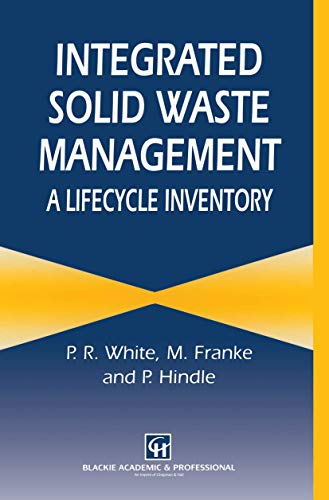
Integrated Solid Waste Management : a lifecycle inventory
Material type: TextPublication details: Glasgow : Blackie Academic & Professional, 1995.Edition: First EditionDescription: xvii, 362p. 28cm; Include Appendices and IndexISBN:
- 9781468467079
- 363.7285 WHI
| Item type | Current library | Collection | Shelving location | Call number | Status | Barcode | |
|---|---|---|---|---|---|---|---|
 Books |
Unity College Library | Non-fiction | Environmental Studies | 363.7285 WHI (Browse shelf(Opens below)) | Available | 12019 |
Browsing Unity College Library shelves,Shelving location: Environmental Studies ,Collection: Non-fiction Close shelf browser (Hides shelf browser)


1 Introduction
Summary
1.1 What is waste?
1.2 Environmental concerns
1.2.1 Conservation of resources
1.2.2 Pollution
1.3 Environmental objectives
1.4 Current approaches: legislation
1.4.1 End-of-pipe regulations
1.4.2 Strategic targets
1.5 Economic costs of environmental improvements
1.6 An integrated approach to solid waste management
References
2 Integrated waste management
Summary
2.1 Basic requirements
2.1.1 Less waste
2.1.2 Effective solid waste management
2.2 Waste management systems
2.2.1 Characteristics of an effective system
2.2.2 The importance of an holistic approach
2.3 A hierarchy of waste management options?
2.2.3 A total quality system
2.4 Modelling waste management
2.4.1 Why model?
2.4.2 Previous modelling of waste management
2.4.3 Using lifecycle assessment for waste
References
3 Lifecycle inventory: a part of lifecycle assessment
Summary
3.1 What is lifecycle assessment?
3.2 Benefits of the lifecycle approach
3.3 Structure of a lifecycle assessment
3.3.1 Goal definition
3.3.2 Inventory
3.3.3 Impact analysis
3.3.4 Valuation
3.4 Current state of development
3.5 Environmental and economic lifecycle assessments
3.6 Lifecycle inventory in reverse
References
4 A lifecycle inventory of solid waste
Summary
4.1 Integrated waste management and lifecycle inventory
4.2 A lifecycle inventory of waste
4.2.1 Goal definition
4.2.2 The inventory stage
4.2.3 Results of the model: system inputs and outputs
4.2.4 Fuel and electricity consumption in the lifecycle of solid waste
4.3 The economic LCI
4.4 The computer spreadsheet
4.5 The relationship between a lifecycle inventory for waste and product or packaging lifecycle inventories
References
5 Solid waste generation
Summary
5.1 Introduction
5.2 Solid waste generation in Europe
5.3 Solid wastes dealt with in this study
5.4 Quantities of municipal solid waste (MSW) generated
5.5 Composition of MSW
5.5.1
By source
5.5.2 By materials
5.5.3 By chemical composition
5.6 Variability in MSW generation
5.7 Effects of source reduction
5.8 MSW classification: need for standardisation
5.9 MSW analysis methods
5.10 Defining the waste input for the LCI computer spreadsheet
5.10.1 Data sources
5.10.2 Classification of solid waste used in the lifecycle inventory
5.10.3 Operation of the waste input module of the LCI spreadsheet
References
6 Pre-sorting and waste collection
Summary
6.1 Introduction
6.2 Home sorting
6.3 Bring versus kerbside collection systems
6.4 Collection systems
6.4.1 Dry recyclable materials
6.4.2 Biowaste and garden waste
6.4.3 Hazardous materials in household waste
6.4.4 Bulky waste
6.5 Integrated collection schemes
6.4.5 Restwaste
6.6 Environmental impacts
6.6.1 Transport impacts
6.6.2 Other impacts
6.7 Economic costs
6.7.1 Material bank systems
6.7.2 Kerbside collection systems
6.8 Operation of the collection module of the LCI spreadsheet
References
7 Central sorting
Summary
7.1 Introduction
7.2 Central sorting of recyclables at a materials recovery facility (MRF)
7.3 Sorting of mixed waste for refuse-derived fuel (RDF)
7.4 Environmental impacts: input-output analysis
7.4.1 MRF sorting
7.4.2 RDF sorting
7.5 Economic costs
7.5.1 MRF sorting
7.5.2 RDF sorting
7.6 Operation of the central sorting module of the LCI spreadsheet
References
8 Materials recycling
Summary
8.1 Introduction
8.2 Materials recycling processes
8.2.1 Transportation
8.2.2 Paper and board
8.2.3 Glass
8.2.4 Ferrous metal
8.2.5 Non-ferrous metal
8.2.6 Plastic
8.2.7 Textiles
8.3 Environmental impacts: input-output analysis
8.3.1 Transport
8.3.2 Paper
8.3.3 Glass
8.3.4 Ferrous metal
8.3.5 Aluminium
8.3.6 Plastics
8.3.7 Textiles
8.4 Economic costs
8.5 Operation of the materials recycling module of the LCI spreadsheet
References
9 Biological treatment
Summary
9.1 Introduction
9.2 Biological treatment objectives
9.2.1 Pre-treatment for disposal
9.2.2 Valorisation
9.3 Overview of biological treatment in Europe
9.4 Biological treatment processes
9.4.1 Pre-treatment
9.4.2 Aerobic processing: composting
9.4.3 Anaerobic processing: biogasification
9.5 Compost markets
9.6 Compost standards
9.7 Environmental impacts: input-output analysis
9.7.1 Defining the system boundaries
9.7.2 Inputs
INTEGRATED SOLID WASTE MANAGEMENT
9.7.3 Outputs
9.7.4 Other considerations
9.8 Economic costs
9.9 Operation of the biological treatment module of the LCI spreadsheet
References
10 Thermal treatment
Summary
10.1 Introduction
10.2 Thermal treatment objectives
10.3 Current state of thermal treatment in Europe
10.4 Mass burn incineration of MSW
10.4.1 The incineration process
10.4.2 Energy recovery
10.4.3 Emission control
10.4.4 Treatment of solid residues
10.5 Burning of refuse-derived fuel
10.6 Burning of source-separated paper and plastic
10.7 Emission limits
10.8 Public acceptability
10.9 Environmental impacts: input-output analysis
10.9.1 Defining the system boundaries
10.9.2 Data availability
10.9.3 Inputs
10.9.4 Outputs
10.10 Economic costs of thermal treatment
10.11 Operation of the thermal treatment module of the LCI spreadsheet References
11 Landfilling
Summary
11.1 Introduction
11.2 Landfilling objectives
11.3 Current landfilling activity in Europe
11.4 Landfilling methods
11.5 Environmental impacts: input-output analysis
11.5.1 Landfill inputs
11.5.2 Landfill outputs
11.6 Economic costs
11.7 Operation of the landfilling module of the LCI spreadsheet
References
12 The overall picture
12.1 Introduction
12.2 From lifecycle inventory results to sustainability
12.3 Making comparisons
12.4 A case study
Identifying improvement opportunities
12.5
12.5.1 The importance of operations in the home
12.5.2 System improvements
12.6 Future directions
12.7 Operating the IWM-1 LCI spreadsheet
References
Postscript
Appendix 1-Secondary materials nomenclature
Appendix 2-Waste analysis procedure
Appendix 3-Programme ratios
Appendix 4-Terms and definitions
Appendix 5 - Currency conversion values
Appendix 6 - How to use IWM-LCI spreadsheet
Indexes
Figures
Tables
Boxes
LCI Boxes
LCI Data Boxes
Subjects
Authors cited
There are no comments on this title.