
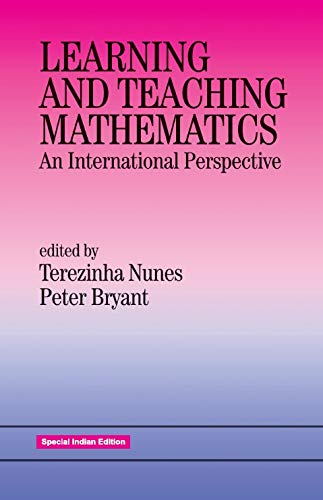
Learning and Teaching Mathematics: An International Perspectives
Material type: TextPublication details: New York: Psychology Press, 2020.Description: xiv,443p, 24cm; Include Reference and IndexISBN:
- 9781138385610
- 510.71 NUN
| Item type | Current library | Collection | Shelving location | Call number | Status | Barcode | |
|---|---|---|---|---|---|---|---|
 Books |
Unity College Library | Non-fiction | TEACHER EDUCATION | 510.71 NUN (Browse shelf(Opens below)) | Available | B3228 |
Browsing Unity College Library shelves,Shelving location: TEACHER EDUCATION,Collection: Non-fiction Close shelf browser (Hides shelf browser)

|

|
|

|

|
|
|
||
| 510.71 KHA Pedagogy of Mathematics | 510.71 MOH Pedagogy of Mathematics | 510.71 MOH Pedagogy of Mathematics | 510.71 NUN Learning and Teaching Mathematics: An International Perspectives | 510.71 RAJ Pedagogy of Mathematics | 510.71 RAJ Pedagogy of Mathematics | 510.71 RAJ Pedagogy of Mathematics |
Contributors xi
About this book: A brief overview T. Nunes and P. Bryant
PART I MATHEMATICS AND INTELLIGENCE 1
1 The nature of mathematical concepts
Gérard Vergnaud
Introduction
The theory of conceptual fields
Elementary algebra and formal calculations
26 Tool-concepts and object-concepts
Conclusion 27
2 Systems of signs and mathematical reasoning
Terezinha Nunes 29
Why do we need the idea of mediated action when discussing mathematical knowledge? 29
Variations in systems of signs and their impact on 32
children's reasoning
The connection between systems of signs and different practices in mathematics 40
Lessons from the analysis of mediated activity for the mathematics classroom 42vi CONTRIBUTORS
UNDERSTANDINGS
PART II THE DEVELOPMENT OF MATHEMATICAL 45
Peter Bryant3 Mathematical understanding in the nursery school years
Do children have genuine mathematical experiences in the pre-school period? 53
Counting 54
Sharing and one-to-one correspondence
Sharing and division 63
Adding and subtracting
Conclusions 67
4 Word problems: A vehicle for promoting authentic mathematical understanding and problem solving in the primary school?
L. Verschaffel and E. De Corte 69
Introduction 69
Classifications of word problems
70
Representing arithmetic word problems
76
Selecting and executing the arithmetic actions
83
Interpreting and verifying the answer 93
Conclusions and future perspectives 94
welvyovo sind A Mood niti imedAcknowledgements 97
5 Children's understandings of turn and angle
Sandra Magina and Celia Hoyles
General framework of the study 99
Children's conception of ang
Introduction to the study 101
Activities with cardboard watches
103
Results from the prediction activities
108
Results from the tasks of comparing times
111
Conclusions
113
6 Knowing about proportions in different contexts
Janice A. Singer, Amy S. Kohn and Lauren B. Resnick
Introduction
115
118
Steibor
Protoquantitative reasoning
First steps to quantification: Protoratios
126
True ratios: Scalar and functional reasoning
128
Concluding discussion
130
navblads
T
Acknowledgements
132
angie
ADCONTENTS
7 Mathematical concepts at the secondary school level: The learning of algebra and functions
Carolyn Kieran 133
Distinguishing between algebra and functions 133
Algebra 137
Functions 150
Conclusions
156
Acknowledgements
158
PART III SOCIAL AND CULTURAL INFLUENCES ON MATHEMATICS LEARNING 159
8 Happy birthday to you: Early mathematical thinking of Asian, South American, and US children
Herbert P. Ginsburg, Y. Elsie Choy, Luz Stella Lopez, Rebecca Netley and Chi Chao-Yuan 163
Introduction
The present study 171
163
Method 171
Results 176
Discussion 196
Conclusions 200
Acknowledgements 201
Appendix: Birthday party game
9 Learning arithmetic with an abacus
Giyoo Hatano 209
How an abacus is used and learned
Becoming a master in mental abacus operation: A case of
routine expertise 214
The abacus makes a difference in arithmetic
Implications for mathematics instruction
Acknowledgements 231
10 What children and teachers count as mathematics
Guida de Abreu, Alan J. Bishop and Geraldo Pompeu Jr.
Introduction
Cognition, beliefs, and attitudes
What children count as mathematics
Educational approaches to cultural conflict
The teachers' perspectivenoitouborsal
Concluding remarks
AcknowledgementsCONTRIBUTORS
11 Social Interactions and Mathematics Learning
M.L. Schubauer-Leoni and A.-N. Perret-Clermont
A first study: Piagetian vs. school tasks 265
265
The meaning attributed to the object in terms of the
questioning context
270
Moving from a bipolar to a tripolar model of knowledge construction 271
The emergence of the notion of a "didactic contract"
The study of the didactic contract via the teacher 273
272
The study of the didactic contract via the pupil 275
The didactic contract and the institutional meta-contract 276
The organized breaking of the didactic contract 277
A psychosocial theory of social interactions and a didactic theory of didactic interactions
278
An example of research into didactic interactions
280
Epilogue
282
Acknowledgement
283
PART IV CONSTRUCTING KNOWLEDGE IN THE CLASSROOM
12
Meaning mathematically with computers
Richard Noss
289
Introduction 289
Mathematical meaning 290
Formalisation 292
Generalisation
298
Abstraction 303
Towards a theoretical framework
309
Mediating between concrete and abstract
Koeno Gravemeijer 315
Introduction 315
Long division with manipulatives
320
Realistic mathematics education
316
Key principles of realistic mathematics education
328
285
Discussion 342
14 Charming fractions or fractions being charmed?
L. Streefland 347
Introduction and overvieWA bird's-eye view on fractions
Some chocolate bars for some children
351
Where do we go from here? A dilemma
352
Table arrangements
353
Dealing with the course of fair sharing
358
On the way to formal operations
361
Discussion
370
15 Didactic engineering
Régine Douady
373
Introduction
373
A. Mathematical knowledge in the didactic relation
374
B. Examples of didactical engineering
378
Conclusion 400
References
403
Author index
433
Subject index 439
There are no comments on this title.