
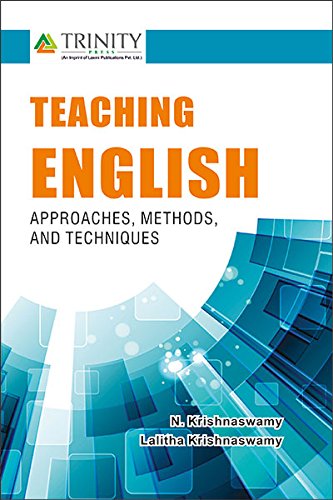
Teaching English Approaches, Methods, And Techniques
Material type: TextPublication details: New Delhi: Trinity Press, 2020Edition: 1st Rev. edDescription: iv,347p. 24cm; Include IndexISBN:
- 9789386035004
- 420.71073 KRI
| Item type | Current library | Collection | Shelving location | Call number | Status | Barcode | |
|---|---|---|---|---|---|---|---|
 Books |
Unity College Library | Non-fiction | TEACHER EDUCATION | 420.71073 KRI (Browse shelf(Opens below)) | Available | B52 | |
|
Books
|
Unity College Library | Non-fiction | TEACHER EDUCATION | 420.71073 KRI (Browse shelf(Opens below)) | Available | B53 |
Browsing Unity College Library shelves,Shelving location: TEACHER EDUCATION,Collection: Non-fiction Close shelf browser (Hides shelf browser)


Section I Theoretical Concepts
1. English as an international, colonial, and national language
1.1 English as a global language 3
1.2 English in India-an
overview 5
1.3 English education during the British colonial period 7
1.4 The role of English during the struggle for independence 13 Question Box 14
2. English in post-independence India2.1 English in contemporary India 17
2.2 Committees and
commissions 18
2.3 The conditions under which English is taught and
learnt in India 29
2.4 Reformulation of the roles assigned to English in
contemporary India 32
Question Box 36
3. Language pedagogy and the teaching of English
3.1 What is language? 37
3.2 Speech and writing 39
3.3 Variants in
language
40 3.4 Some general misconceptions about language 42
3.5 Linguistics and languages teaching 43 3.6 Mother tongue teaching,
foreign language teaching and second language teaching 44-
(a) Mother
tongue teaching/learning 45
(b) Foreign language teaching 45
(c) Secon
language teaching 46
3.7 Psychology and language teaching 47
Questio
Box 50
4. Methods and methods
4.1 Early language pedagogy in the West 52
4.2 The grammar-translatio
4.3 The reform movement and the Direct Method 57twentiethcentury: the first half 62-Daniel Jones 63
Harold Palmer
63 Michael West 64
A.S. Hornby 65
4.5 Approach, method and
technique 66
4.6 The structural approach
and the audio-lingual
method 67
4.7 The Bilingual Method and the use of the mother 4.8 Noam Chomsky and linguistic competence 71
tongue 70
4.9 The twentieth century: the second half 72
Conte
4.10 The eclectic 'method' 81 4.11 Search for alternatives 84 Box 85
Question
Section II Classroom Applications
5. Spoken English and the teaching of spoken English
89-1
5.1 The four skills 89 Part A-5.2 Essentials of spoken English for
teachers 91
1. The music of English: Stress, rhythm and intonation 92
Al. Stress 92
A2. Guidelines for word-stress 95
A3. Shift in
stress 97 A4. Stress change according to function and meaning 98
AS. Sentence-stress and the rhythm of speech 99
B. Rhythm 99
C. Tone and intonation 100
II. Improving pronunciation: sounds and lette
104-A. The 'alphabet' of speaking 104
B. Improving one's own
pronunciation 109 Part B-5.3 Teaching spoken English: Some
techniques 110-A. Young learners 110
B. Secondary school
level 114
C. Tertiary level 115
D. Developing listening skills 117
5.4 More interactive activities 118
Question Box 118
120-1
6. Vocabulary enrichment and the teaching of vocabulary
6.1 Words and words 120
6.2 Enriching one's vocabulary 121
Part A-6.3 Essential word-grammar for teachers 121-
A. Kinds of
words 127
B. Homonyms: homophones and homographs 128
C. Synonyms, antonyms, equivalences, etc. 129
D. Acronyms 130
E. Definitions and one-word substitutes 130
F. Confusables 131
G. Idioms and phrases 131
H. Translation 132
1. Word lists 133
J. Register-based vocabulary 134
Part B-6.4 The teaching of vocabula
135-
A. Young learners 136
B. Secondary school level 139
C. Tertiar
and advanced levels 141
6.5 Read and read 143 Question Box 143
145-
7. English grammar and the teaching of grammar
7.1 To teach or not to teach 145
7.2 Changing perceptions 147
Wren
Martin revisited 149 Part
A-7.3 Grammar clinic for teachers
152-
1. Sentence grammar 152-A
(a) Simple sentence patterns 152
(b) Basic structures 154
B. Complex and compound sentences 162
C. Questions, negatives and passives 163
D. Agreement (also called
concord) 164
E. Reported speech 166
F. Non-finite forms 166
G. Linkers and transition words and phrases 168
II. Punctuation and
grammar 169
7.4 Reverse grammar 170
Part B-7.5 The teaching of
grammar 174,
7.6 An idea-bank 175
A. Young learners 175-
i. Situational pattern practice 175
ii. Substitution-tables 175
iii. 178
iv. Articles 178
v. Adjectives 179
B. Secondary/tertiary level 180-
i. Articles 180
ii. Prepositions 181
iii. Tenses 183
iv. Reporting 183 C.
Tertiary/advanced
185-i. Reporting questions 185
ii. The use of
passives 185
iii. Non-finite forms of verbs 187
Question Box 187
189-213
8. Reading, writing, and the teaching of composition
iii
8.1 Reading, writing, and thinking 189
8.2 Reading and the teaching of
reading 190
8.3 Styles of reading:
scanning and skimming 190
8.4 Intensive
and extensive reading 192
8.5 The teaching of reading in the
early stages 195
8.6 Writing and the
teaching of writing 196
8.7 The teaching of composition 199-
A. Young learners 199
B. Secondary school stage 201
Question Box 213
C. Tertiary and advanced levels 204
9. The teaching of prose and poetry
214-2
9.1 The teaching of English literature 214 9.2 The teaching of prose:
intensive reading 216
-A. Teaching prose at the school level 219
B. Teaching prose at the tertiary level 224
9.3 Poetry: Some basics for
teachers 229-
A. Kinds of poetry or poetic genres 229
B. Prosody 230
C. The figurative use of language 233
D. The essence of teaching
poetry 235
9.4 The teaching of poetry 236-
A. Poetry for young
learners 236
B. Teaching poetry at the secondary and tertiary
levels 238
Question Box 244
10. Instructional aids and study aids
245
Part A: The use of the blackboard and other instructional aids and stuc
aids-10.1 Instructional aids 245
10.2 Other simple teaching-learnin
aids
247 10.3 Using technology for language teaching 248
Part B: Study aids-10.4 Study skills and reference skills 253-information and the use of reference books 254
B. Gathering
information 256
C. Storing skills 257
D. Retrieving skills 262
Question Box 264
There are no comments on this title.