
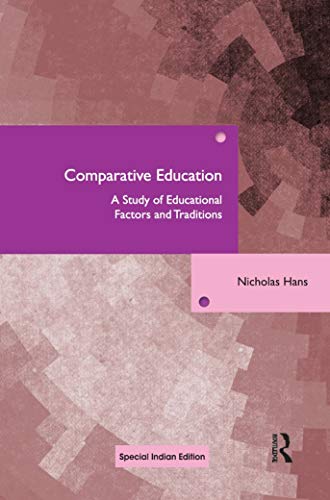
Comparative Education : A study of Educational Factors and Traditions VOL- 4
Material type: TextPublication details: New York: Routledge, 2014.Description: x,333pISBN:
- 9781138385634
- 370 HAN
| Item type | Current library | Shelving location | Call number | Status | Barcode | |
|---|---|---|---|---|---|---|
 Books |
Unity College Library | Education | 370 HAN (Browse shelf(Opens below)) | Available | 11841 |
Browsing Unity College Library shelves,Shelving location: Education Close shelf browser (Hides shelf browser)


CONTENTS
PREFACE
CHAPTER
I. DEFINITION AND SCOPE OF COMPARATIVE EDUCATION
First pioneers of Comparative Education. Other comparative studies. Statistical approach. Psychological approach. Historical approach. National traditions and the definition of a nation. Short survey of contents.
PART I NATURAL FACTORS
11. THE RACIAL FACTOR
Definition of a race. Heredity. Racial problems in education. Educational policy in British dependencies. Policy of the French Empire. Racial problem in Latin America. Educa-tion of Maoris in New Zealand. Racial entanglement in South Africa. Intelligence of the Black Africans. Negro education in the U.S.A.
III. THE LINGUISTIC FACTOR
Language as repository of racial and national experience. Language as medium of instruction. Imposition of a foreign language and its results. Various linguistic groups. Bilingual-ism in Belgium. Bilingualism in South Africa. Four languages in Switzerland. Two languages in Canada. The revival of Irish. Bilingualism in Wales. The solution of linguistic pro-blems in the U.S.S.R. Two national languages in Norway. The linguistic problem of China.
IV. GEOGRAPHIC AND ECONOMIC FACTORS.
63
The influence of climate and geography. The case of Australia. History and Geography as factors in the U.S.A. and Canada. Economic factors. Industrial revolution in England and gradual adaptation of education to new conditions. Russia before the Soviet Revolution. Socialist and industrial recon-struction and rapid adaptation of the educational system. Educational Finances. Equalisation of burdens. The English system.
PART II RELIGIOUS FACTORS
V. RELIGIOUS TRADITIONS OF EUROPE
East and West. Three religious traditions in Europe. Catholi-cism. Protestantism. Eastern Orthodoxy. Catholic medieval tradition in education. Lutheran tradition in Germany and Scandinavia. Byzantine tradition in the south-east of Europe. The Slavonic Church. The Russian Orthodox Church. The influence of Islam. Comparison of different parts of Europe by religious traditions.
CHAPTER
VI. THE CATHOLIC TRADITION
The struggle with Protestantism and differentiation of Catholic policy. The Society of Jesus. The Jansenists: Oratoire and Port Royal. De la Salle and the Christian Brothers. Inquisi tion and the Jesuits in Spain. Latin America. Catholics in Protestant countries. Separate Catholic school systems in the English-speaking countries. Catholic Church in Ireland and Quebec, Canada. Catholics in the British Dominions and the U.S.A. Ultramontanism.
VII. THE ANGLICAN TRADITION
The intermediate position of the Church of England. The class policy of the Church. Schools for the élite and schools for the poor. The Evangelicals and the High Church Party. Christian Socialism. The Great Public Schools. Anglican Churches in Scotland and Ireland. The policy of the Church in Canada and other Dominions. Episcopalian Church in America.
VIII. THE PURITAN TRADITION
Calvinism in Switzerland. Two traditions within the Calvinist communities. The Huguenots in France. Arminians and Precisians in Holland. Presbyterians, Independents and 아 Baptists in England. Dissenting Academies. Presbyterian Church of Scotland. The scheme of John Knox. Calvinism in the Dominions. The Puritans of America. Theocracy in Massachusetts and freedom in Rhode Island. Gradual change from orthodoxy to liberalism.
PART III SECULAR FACTORS
IX. HUMANISM
174
Broad and narrow meaning of Humanism. The causes of Humanism in Italy. Platonic Academies. Bacon and Descartes. English Deism. John Comenius. Rosicrucians and Freemasons in England. Private Academies of the eighteenth century. The French Enlightenment. The struggle with the Church of Rome. American Humanism. Franklin and Jefferson. The French Revolution. Pestalozzi and Froebel. Scientific movement in England. John Dewey.
195
X. SOCIALISM Socialism of Plato. Sir Thomas Moore. Rousseau, Condorcet and Pestalozzi as precursors of Socialism. Utopian Socialists, Saint Simon, R. Owen and Cabet. Scientific Socialists, Marx, Engels, Bebel and Lenin. Idealistic Socialists. P. Natorp. The British Socialists. Socialist education in the U.S.S.R.; Mexico; Bulgaria and Yugoslavia.
CHAPTER
XI. NATIONALISM
Humanistic nationalism. Fichte in Germany. Mazzini in Italy. Panslavism. The Czech "Awakeners." Palacky. The quarrel of nationalities after 1848. Fascim in Italy. Gentile and Bottai. National-Socialism in Germany. Blood and Soil. Hitler's ideal. Panslavism after the War.
XII. DEMOCRACY AND EDUCATION
Definition of democracy. Political and Social Democracy. The Western and Eastern European interpretations and their limitations. The equality of educational opportunities in the West and the East. The State and the Church. Monopoly and the Dual system. Tolerance and political indoctrination. Educational Highway. Education of Women.
PART IV EDUCATION IN FOUR DEMOCRACIES
XIII. THE EDUCATIONAL SYSTEM OF ENGLAND
Education Act 1944. Central and Local administration. The Primary stage. The differentiation of Secondary Education. Technical Education. Public Schools. Universities. Adult Education. Religious difficulty.
XIV. THE EDUCATIONAL SYSTEM OF THE U.S.A..
Federal, State and local educational authorities. Inequality of opportunities. Primary Schools. Secondary and Technical Schools. Senior High School and Junior College. Private agencies. Universities. Adult Education.
XV. THE EDUCATIONAL SYSTEM OF FRANCE
Centralisation of administration. Independent Catholic system. L'École unique. Primary education. Secondary and Technical education. Culture générale. Universities. Regionalism. Post-war reforms.
XVI. THE EDUCATIONAL SYSTEM OF THE U.S.S.R.
Federal, Republican and local authorities. Pre-School educa-tion. Primary Schools. Secondary education. Technical and industrial education. Higher Institutions. New tendencies. Return to "culture."
CONCLUSION
BIBLIOGRAPHY
INDEX
There are no comments on this title.