
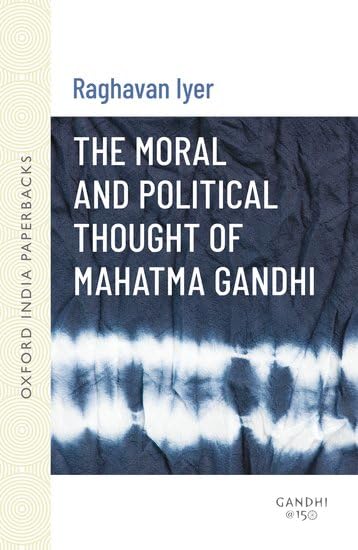
The moral and political thought of Mahatma Gandhi
Material type: TextPublication details: New Delhi; Oxford University Press, 2018.Edition: Tenth impressionDescription: xiii, 449 p. includes notes, bibliography, glossary and indexISBN:
- 9780195651959
- 172.0954
| Item type | Current library | Shelving location | Call number | Status | Barcode | |
|---|---|---|---|---|---|---|
 Books |
Unity College Library | Political Science | 172.0954 IYE (Browse shelf(Opens below)) | Available | 7650 |
Browsing Unity College Library shelves,Shelving location: Political Science Close shelf browser (Hides shelf browser)


CONTENTS.
1. Introduction.
2. The indictment of modern civilization.
3. The purification of politics : Religion and politics---The concept of power---The doctrine of double standards.
4. The need for absolute values and for vows : Moral commitment---Absolute values and eternal principles---The need for vows---Pledges and contracts.
5. Human nature progress and perfectibility : The concept of human nature---Original goodness and human perfectibility---The interpretation of history---Assessment.
6. Individual conscience and heroism in society : The individual and society---The exaltation of conscience---The Socratic Daimon and Gandhi's inner voice---The concept of conscience in the west and in India---The heroic ideal---Political leadership and the masses---Conscience and heroism.
7. Satya Absolute and relative truth : The concept of satya---Truth is God---Absolute and relative truth---The vow of truth---Truth in politics and society---The significance of satya.
8. Ahimsa Nonviolence as a creed and a policy : The meaning of Ahimsa---Ahimsa in politics and society---Ahimsa as a creed and as a policy---Unavoidable himsa---Critics of Ahimsa---Assessment---Appendix attitudes toward nonviolence before Gandhi.
9. Satya and Ahimsa the relation between truth and nonviolence : Satya and Ahimsa---Moksha and Tapas---Tolerance and civility.
10. Satyagraha active and passive resistance : The state and the citizen---The doctrine of passive resistance---The doctrine of satyagraha.
11. The scope and significance of Satyagraha : The scope and application of satyagraha---The limits and abuse of satyagraha---Criticisma and Assessment.
12. Swaraj and Swadeshi self rule and self reliance.
13. Means and ends in politics.
14. Assessment.
There are no comments on this title.